
Hey Professors,
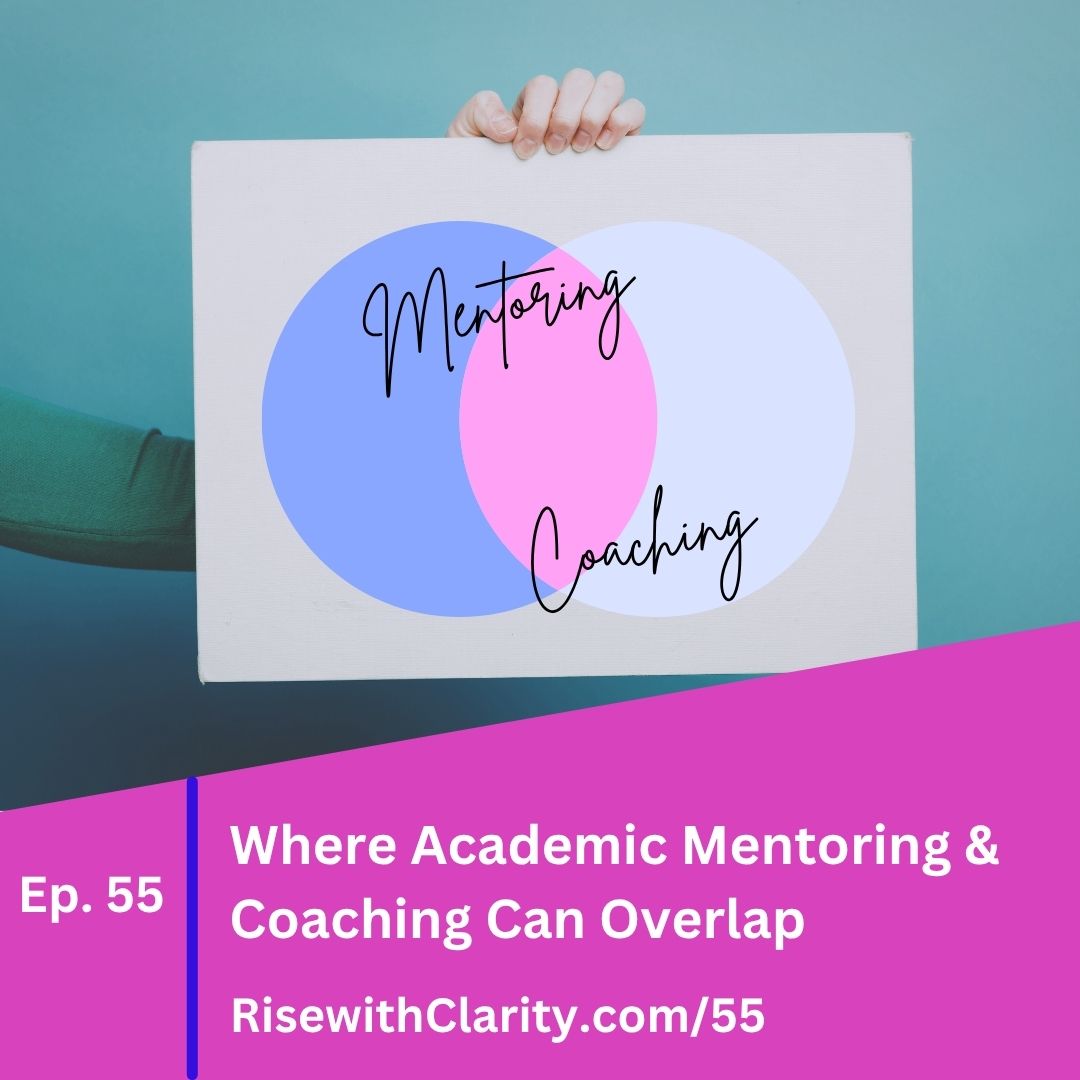
How can the domains of academic mentoring and professional coaching overlap? And when might you find yourself gravitating towards working with someone who offers a blend of these approaches?
For instance, are there times when you want mentorship from a senior colleague at your institution but don’t necessarily want to be told what to do? After all, the exact steps that your mentor followed in their career are not ones that you intend to follow. And moreover, the landscape of higher education is changing so rapidly at the moment that you’re not sure that what worked in the past is going to hold up today.
On the flip side, even though you like the idea of having a supportive thinking partner in plotting out the next steps to your promotion, you’re a little apprehensive about hiring an executive or a leadership coach because their background is from the corporate world, not the academic one. Plus, the price point is pretty steep.
So, perhaps what you’re discovering is that you’d like to have the best of both worlds of mentoring and coaching when looking for some tailored support. And you wonder—is this even possible?
In this 55th episode of the Rise with Clarity Podcast, I’m going to be talking about the ins and outs of this middle area, where academic mentoring and professional coaching can sometimes meet up and overlap.
My Journey into Professional Coaching from Academia
I want to start off by sharing a little bit about my journey into professional coaching before we get into the topic at hand. I first started coaching—on a very small scale—in 2021 when I was still a full-time tenured professor. It was a year of exploration for me, when I started to consider what possibilities lie beyond tenure and what a pivot could even look like for me.
As I’ve mentioned before on this podcast (Episode 32) and elsewhere, I decided to take an 8-month course on arts and culture strategy with the thoughts of pivoting into arts administration or arts management, and I also took on 1 coaching client at the beginning of that year—which ended up growing to 6 by the fall of that year.
It became clear to me by the end of 2021 (which coincided with a health scare which I talk about in Episode 9) that coaching was most likely going to be my path forward, and that I could learn and grow a lot by pursuing this new pathway.
I signed up for a set of Higher Ed Coach Training courses with Dr. Katie Linder in 2022, which I would highly recommend to anyone interested in learning more about coaching in the higher ed environment.
So, in the year before I started my coach training, I leaned heavily on my experiences as an advisor and as a mentor for undergraduate and graduate students in my coaching sessions. And I think this was a very natural thing for me to do. I did a lot of listening, but I also did give my share of advice and guidance. And a lot of what I was doing at the very beginning was kind of “coaching on vibes.”
In coach training in 2022, I learned that I needed to dial back my mentoring presence considerably in coaching sessions. This is because professional coaches who are trained according to the guidelines, principles and ethics of the International Coaching Federation (or ICF for short) are not supposed to give advice in a coaching session.
Rather, they listen actively and serve as a nonjudgmental, supportive thinking partner and sounding board for the client.
And unlike the hierarchy and inherent power dynamics that exist in a mentor-mentee relationship, the coach is an equal thinking partner with the client. And coaches also believe that the client is creative, resourced, and whole, and ultimately able to come up with their own best solutions, as they are the expert of their own life.
Now for many folks who are unfamiliar with professional coaching, this aspect is surprising to learn about because they assume that a coach operates very similarly to a mentor. They may even be seeking to hire a coach precisely because they want advice on a given topic, like how to write and publish a book or how to navigate a career change successfully.
So I want to talk here a little bit about why I think that there is this confusion over what professional coaching entails. I do believe there are a couple of reasons.
4 Reasons Why There is Confusion Over What Professional Coaching Is
1) A lot of this stems from the fact that coaching is an unregulated industry. Anyone can begin a coaching business, including you. There isn’t any legal board or regulatory board from preventing you from hanging out your shingle and creating a website offering coaching services.
2) And that leads to my second point. There is a very wide spectrum of coaching that one can receive. And just think about the different categories of coaching topics that are out there: life coaching, higher ed coaching, leadership coaching, retirement coaching, so on and so forth.
Some of this is going to be straight up advice giving, some of it will be in the middle ground, and some of it will follow the model of what some call “pure coaching”—or sometimes called non-directive coaching that is a non-advisory approach where coaches use powerful reflective questions to empower clients rather than providing advice or mentoring.
3) My third point is that there are so many different kinds of coach training programs out there. Based on the training that one receives, a new coach coming out of one of these programs like the Life Coach School or Martha Beck’s Wayfinder courses will probably have a certain flavor or method of coaching. A coach coming out of an ICF-accredited program would likely veer more towards the non-advisory approach in coaching sessions.
4) And my fourth point is that there are coaches who offer structured guidance in the longer arc of a coaching engagement while also still modeling a thinking partnership in individual coaching sessions. This is the kind of blended approach that brings together ICF coaching with some elements of guidance and mentorship.
Why a Blended Approach of Mentoring and Coaching May Be Helpful in Higher Ed
This last point is something that I want to reflect on right now. Because I think that this kind of approach can be very powerful and useful in the idiosyncratic landscape of higher education. Working with someone who knows the academic terrain (in the country that you’re living in) can be very helpful. Let’s take for example—the niche of writing coaching.
A writing coach who has published books with academic presses or worked as a professional editor is going to be key if you’re seeking out help and support for writing your academic monograph for the very first time. You’d probably want to work with someone who knows about the structural elements of the academic book writing process and who knows what is entailed in writing an academic book proposal, for instance.
But in the individual coaching sessions there can be room for you to bring up common coaching topics like time management, prioritization, imposter syndrome, or perfectionism. So you can see where certain elements of mentorship or guidance can coexist with non-directive coaching.
Interestingly enough though, I’ve learned pretty recently that the ICF has recently revised one of their core competencies to allow for coaches to more freely share “knowledge” in the coaching session. Much like using a tool in a session, the coach would ask permission to share their knowledge with the client—without attachment—in a session. This would be done in a way to help support the client and to also evoke awareness in them.
OK. I may have just nerded out and given you a little bit more information than you needed on this coaching piece or than you expected in this podcast episode. But I hope that it goes to show that academic mentoring and professional coaching has more overlap than being mutually exclusive domains.
And I should also mention that mentoring—and the rethinking of mentorship from traditional 1-1 models to more networked models in higher ed may actually move to incorporate some non-directive elements—elements that are more associated with professional coaching. Check out the chapter on “Mentoring like a Coach” in Maria LaMonaca Wisdom’s recently published book on How to Mentor Anyone in Academia.
Rise with Clarity’s 6-Month Signature Program for Women of Color Faculty
I did want to share that in my own coaching practice, I offer a blended approach of mentorship and coaching by creating some structured guidance in the longer arc of a coaching engagement, along with giving my clients the freedom and flexibility to design their agendas in individual coaching sessions.
In my 6-month signature program for women of color faculty on the tenure track, I do review documents like tenure statements and dossiers as well as grant proposals that may be instrumental for securing time for research and writing. But I typically do that work in between coaching sessions, so as to allow my clients the ability to fully direct their own agendas for the individual sessions.
The topics that come up in sessions usually fall under larger categories of:
Reclaiming Time and Setting Priorities,
Navigating Politics,
Speaking Up and Gaining Recognition, and
Designing a Sustainable Path Forward—whether that involves ramping up in higher education or pivoting out.
If you’re ever curious about this kind of coaching and/or working with me, feel free to reach out to me for a 30-minute free exploratory call. You can find all that info at my website at RisewithClarity.com under the Work with Katherine tab. I’d love to hear from you.